The proposal looked great.
It was polished, professional, and exactly the kind of document that makes a business look like it has everything under control.
Then the client called.
The market research cited in section two — the statistics that anchored the entire recommendation — didn’t exist. The AI had made them up.
Not vaguely. Not accidentally. Confidently and in detail.
There’s a name for this: a hallucination. And it happens when businesses hand powerful AI tools access to real work without putting any guardrails around how they’re used.
Sound familiar?
The Intern Nobody Onboarded
Imagine hiring a brand-new intern and, on day one, giving them access to everything.
Client files. Internal reports. Financial summaries. Email drafts.
Then saying:
"Just figure it out."
No training. No supervision. No policies. No boundaries.
That’s how a lot of businesses are adopting AI right now.
Not because they’re careless — honestly, it’s usually the opposite. AI tools are genuinely helpful. They save time. They summarize meetings. They draft emails. They organize information in seconds.
And now they’re built into almost every platform your team already uses.
There’s an AI button in your inbox. Another in your document editor. Another in your CRM.
It feels convenient because it is convenient.
But convenience without oversight is where risk sneaks in.
What’s Actually Happening Behind the Scenes
When AI tools show up without a clear plan, three things tend to happen quickly.
1. Sensitive Data Starts Getting Shared
An employee pastes a client contract into a free AI chatbot to summarize it.
Someone uploads financial details to help draft a report.
Another person copies policyholder information into an AI writing tool because they’re trying to save time.
The problem is that many consumer-grade AI platforms may retain or use submitted information to improve their systems. Most employees don’t realize they could be exposing confidential business or client data in the process.
And in insurance, that matters.
Minnesota agencies already operate under strict expectations around protecting nonpublic information. Client trust is everything. One accidental data exposure can quickly become a compliance issue, a reputation issue, and a client retention issue all at once.
2. “Shadow AI” Starts Spreading
Here’s what happens in most offices:
One employee finds a tool they like.
Then another.
Then suddenly half the company is using AI platforms leadership never approved.
IT doesn’t know what tools are connected to company systems. Leadership doesn’t know where information is being shared. Nobody has reviewed the privacy policies or security standards.
It’s the modern version of shadow IT — except faster and much harder to track.
And the scary part?
Most people aren’t trying to break rules. They’re trying to work faster.
3. People Trust AI Output Too Much
This might be the biggest risk of all.
AI sounds confident.
It writes cleanly. Professionally. Convincingly.
But confidence and accuracy are not the same thing.
AI can invent statistics. Misstate regulations. Reference sources that don’t exist. Misinterpret policy language. Summarize something incorrectly while sounding completely certain.
That’s what makes it dangerous.
A human intern usually asks questions when they’re unsure. AI rarely does.
Which means if nobody reviews the work carefully before it goes out, mistakes scale quickly.
And in insurance, small mistakes can become expensive problems.
AI Doesn’t Fix Broken Processes. It Accelerates Them.
This is the part many agencies are missing.
AI is not a strategy.
It’s an accelerator.
If your workflows are organized, secure, and well-managed, AI can help your team move faster and serve clients better.
But if your processes are inconsistent, undocumented, or loosely controlled, AI simply helps mistakes happen more efficiently.
That’s why smart agencies are focusing less on whether to use AI and more on how to use it responsibly.
So What Should Agencies Actually Do?
The answer is not banning AI.
That ship has sailed.
Your employees are already encountering AI tools every day, whether leadership formally approved them or not.
The real goal is supervision.
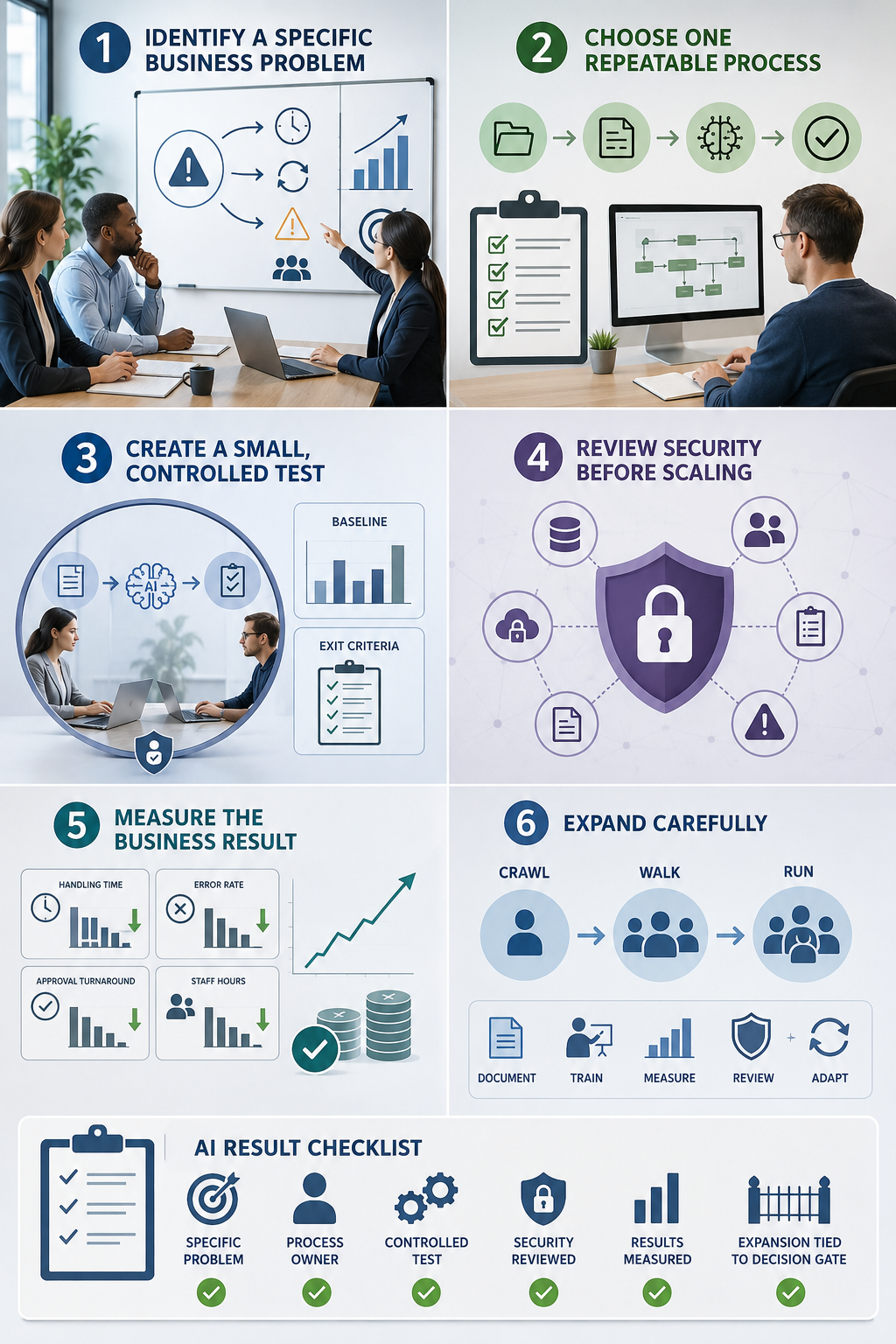
Think of AI the same way you’d think about onboarding a new employee with enormous potential and zero context.
Set Clear Boundaries
Start simple.
Decide which AI tools are approved and which are not.
Your team does not need twenty different platforms doing the same thing. A short approved-tools list creates clarity without slowing people down.
Create a Human Review Step
AI drafts.
Humans approve.
Nothing client-facing should go out without someone reviewing it first — especially proposals, coverage explanations, compliance-related content, or anything involving sensitive information.
This single habit eliminates a surprising amount of risk.
Teach Employees What Should Never Be Shared
Client names.
Financial records.
Policy details.
Employee information.
Protected health information.
If your team doesn’t know where the line is, they’ll cross it accidentally.
Most risky AI behavior doesn’t come from bad intentions. It comes from unclear expectations.
Build AI Into Your Security Conversations
AI governance is becoming part of cybersecurity now.
That means agencies should begin discussing:
- Approved AI usage
- Data handling policies
- Vendor oversight
- Privacy controls
- Compliance implications
- Employee training
- Incident response planning
Because eventually, clients and carriers are going to ask.
And “we haven’t really thought about it yet” is not an answer anyone wants to give.
The Agencies That Win Will Use AI Carefully — Not Fearfully
AI is here to stay.
And truthfully, it can become a real competitive advantage for insurance agencies that use it wisely.
The agencies that struggle won’t necessarily be the ones using AI.
They’ll be the ones who never decided how it should be used in the first place.
You don’t need to become a technology expert overnight.
You just need a framework that protects your business, your clients, and the reputation you worked hard to build.
Because at the end of the day, trust is still the product.
AI just changes how carefully we have to protect it.
.png)