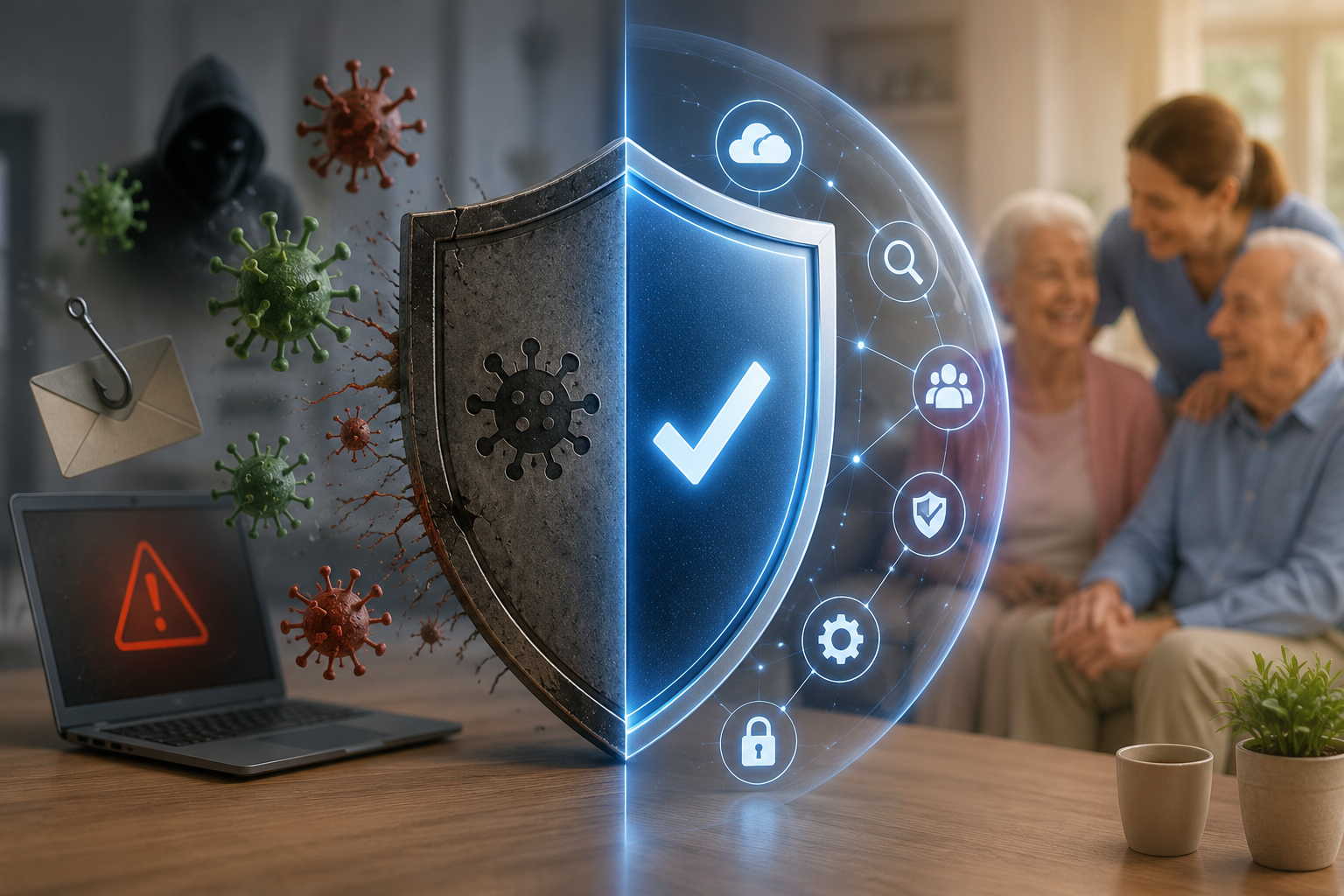
Most senior care leaders assume that if they have antivirus software installed, they're protected from cyber threats.
Unfortunately, that's no longer true.
Cybercriminals have become more sophisticated, and the tools they use today are very different from the viruses and malware of the past. While traditional antivirus still plays an important role, relying on it alone is a bit like locking your front door while leaving all the windows open.
For assisted living and senior care communities, the stakes are especially high. A cyberattack doesn't just affect computers. It can disrupt resident care, expose sensitive health information, and damage the trust families place in your organization.
How Traditional Antivirus Works
Traditional antivirus software is designed to identify known threats. It compares files and programs against a database of known malware and blocks anything that matches.
Think of it like a security guard checking a list of known troublemakers. If someone's name is on the list, they're stopped. If they're not on the list, they're allowed in.
The problem is that today's cybercriminals constantly create new threats that haven't been identified yet.
Modern Threats Don't Always Look Suspicious
Many of today's attacks start with something simple:
- A phishing email that looks legitimate
- A stolen password
- A staff member clicking a link that appears safe
- An infected file that bypasses traditional detection
In these situations, traditional antivirus may not recognize the threat because it has never seen it before.
That's why modern cybersecurity solutions focus on behavior, not just known threats.
Instead of asking, "Is this a known criminal?" modern security asks, "Is someone acting suspiciously?"
What Modern Protection Looks Like
Today's security tools provide multiple layers of protection designed to identify threats before serious damage occurs.
Endpoint Detection and Response (EDR)
EDR continuously monitors devices for unusual activity.
For example, if a program suddenly begins encrypting large numbers of files—a common sign of ransomware—EDR can detect the behavior and stop the attack before it spreads.
Real-Time Monitoring
Cyber threats don't wait for scheduled scans.
Real-time monitoring watches systems around the clock and alerts security teams when suspicious activity occurs.
Automatic Updates
Cybercriminals are constantly evolving their tactics. Security tools must evolve just as quickly.
Automatic updates ensure your protection stays current without relying on someone to remember to update software manually.
Cloud-Based Protection
Today's workforce is mobile. Staff may access systems from different locations, work remotely, or use cloud-based applications.
Cloud-based security helps protect users and devices wherever they are.
Integrated Security Tools
The strongest security solutions work together.
Email security, endpoint protection, monitoring, backups, and user training should all support one another to create a stronger defense.
Why This Matters for Senior Care Communities
Senior care organizations are increasingly targeted because they hold valuable information and often have limited internal IT resources.
Cybercriminals know that disruptions to care operations create urgency, making healthcare and senior living organizations attractive targets for ransomware attacks.
A successful attack can lead to:
- Interrupted resident care
- Loss of access to critical systems
- HIPAA compliance concerns
- Financial losses
- Reputational damage
- Loss of family trust
The impact goes far beyond technology.
At its core, cybersecurity is about protecting the residents, families, and staff who depend on your organization every day.
A Simple Security Check
If you're not sure whether your current protection is enough, ask your IT provider these questions:
- Do we have ransomware protection?
- Can our security tools detect suspicious behavior?
- Are threats monitored in real time?
- Do we have protection against phishing attacks?
- How quickly would we know if a device was compromised?
If the answers aren't clear, it may be time for a deeper conversation.
The Bottom Line
Traditional antivirus remains an important piece of your cybersecurity strategy, but it should no longer be your only line of defense.
Today's threats require a modern approach that focuses on prevention, detection, and rapid response.
The goal isn't just to protect computers.
It's to protect resident information, maintain family trust, support compliance efforts, and ensure your team can continue delivering the exceptional care your residents deserve.
Because when cybersecurity is done right, it's not just about technology.
It's about peace of mind.
.png)