Why Promising AI Experiments Often Stall
Many organizations have already tested generative AI. Employees have drafted emails, summarized meetings, created marketing ideas, or built small automations. These experiments can be impressive, but an impressive demonstration is not the same as a dependable business result.
An AI initiative creates lasting value only when it is connected to a real workflow, owned by someone who is responsible for the outcome, measured against a clear baseline, and reviewed for security and operational risk. Without those elements, a pilot can remain stuck in demonstration mode indefinitely.
The most common problems are surprisingly practical. Teams begin without measuring the current process. No one owns the result after the initial test. There is no decision point for expanding, improving, or stopping the project. Security and privacy questions are postponed until the workflow has already spread. The solution is to treat an AI pilot as a business improvement project, not simply as a technology trial.
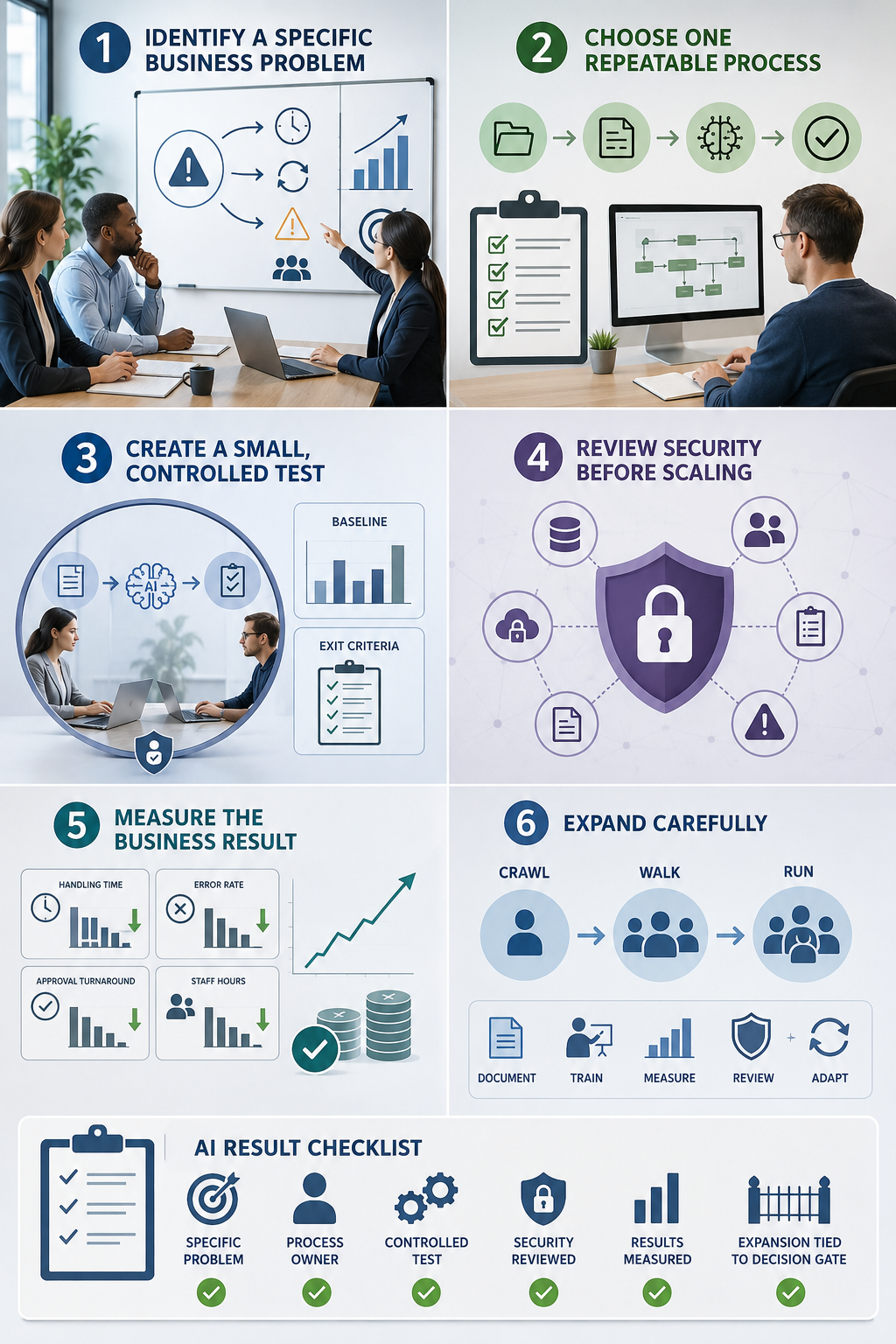
Stage 1: Identify a Specific Business Problem
Start with the pain, not the tool. A useful opportunity is visible, repeated, and important enough that leadership would care if it improved. Look for work that consumes significant time, creates delays, produces rework, causes missed handoffs, or makes service inconsistent.
A strong problem statement names the workflow, the owner, and the desired result. For example, “Our invoice approval process requires repeated manual entry, takes several days, and creates avoidable rework.” That is more useful than saying, “We want to use AI in accounting.”
Ask three questions before moving forward: What work takes too long? Where do errors or delays occur? Which metric would matter if it changed? When the team cannot answer those questions, the idea is not ready for a pilot.
Stage 2: Choose One Repeatable Process
A first AI project should be narrow enough to observe and control. Avoid broad goals such as “use AI across the company” or “automate customer service.” Choose one repeatable workflow with a clear beginning, output, and owner.
The best early candidates share five traits. They occur often enough to produce useful data. One person can approve changes and judge success. Before and after results can be compared. The first test can use safe data with human review. Finally, improvement would create meaningful time, quality, service, or financial value.
Focus is essential. When everything is in scope, nothing can be measured accurately.
Stage 3: Create a Small, Controlled Test
A good pilot is intentionally small. It may involve one team, one workflow, a limited set of data, and one clearly defined output. Human review should remain in place for approvals, exceptions, and high consequence decisions.
Before the pilot begins, capture the current baseline. Measure handling time, error rate, turnaround time, cost, or staff effort. Then define exit criteria. What result would justify expansion? What result would require changes? What result would cause the team to stop?
The purpose of the pilot is not to prove that AI is perfect. The purpose is to gather evidence that supports a responsible decision.
Stage 4: Review Security Before Scaling
Security should be reviewed while the pilot is still small. Determine what data the system can access, how that data is retained, who has permission to use the workflow, and whether outputs require approval. Confirm that the organization has an audit trail and a process for handling exceptions or incidents.
Vendor, model, and connector risk also matter. A workflow may be useful but still inappropriate if it exposes confidential information, grants excessive access, or allows unverified output to bypass normal controls.
Trust is what allows a useful workflow to become repeatable. Building safeguards early is easier than trying to add them after adoption has spread.
Stage 5: Measure the Business Result
A pilot succeeds when the business result changes, not when the demo looks impressive. Compare the new workflow with the baseline using more than one measure.
For an invoice intake pilot, the team might compare average handling time, rework rate, approval turnaround, and staff hours. A successful test could reduce handling time, lower errors, speed approvals, and return capacity to the team. Those improvements should still be weighed against software cost, implementation effort, training, and ongoing oversight.
Measure what leadership cares about. Time saved is useful, but it becomes more meaningful when connected to service capacity, reduced cost, faster cash flow, lower risk, or a better customer experience.
Stage 6: Expand Carefully
Scaling is a business decision, not a reward for enthusiasm. Expand one team or related workflow at a time. Document the process, exceptions, ownership, controls, and success measures before adding more users.
Train each new group with realistic examples. Reuse the same measurement framework. Review security, adoption, and quality at every stage. If the value fades when the workflow reaches a broader audience, revise or stop it. That is useful evidence, not failure.
A crawl, walk, run approach protects the organization while increasing the chance that employees will actually adopt the new process.
A Practical AI Result Checklist
Before scaling an AI workflow, confirm that the problem is specific, the process has an owner, the test is controlled, security has been reviewed, results have been measured, and expansion is tied to a clear decision gate.
The goal is not simply to use more AI. The goal is to create a dependable workflow that makes the business better in a way leaders and employees can see, measure, and trust.

.png)