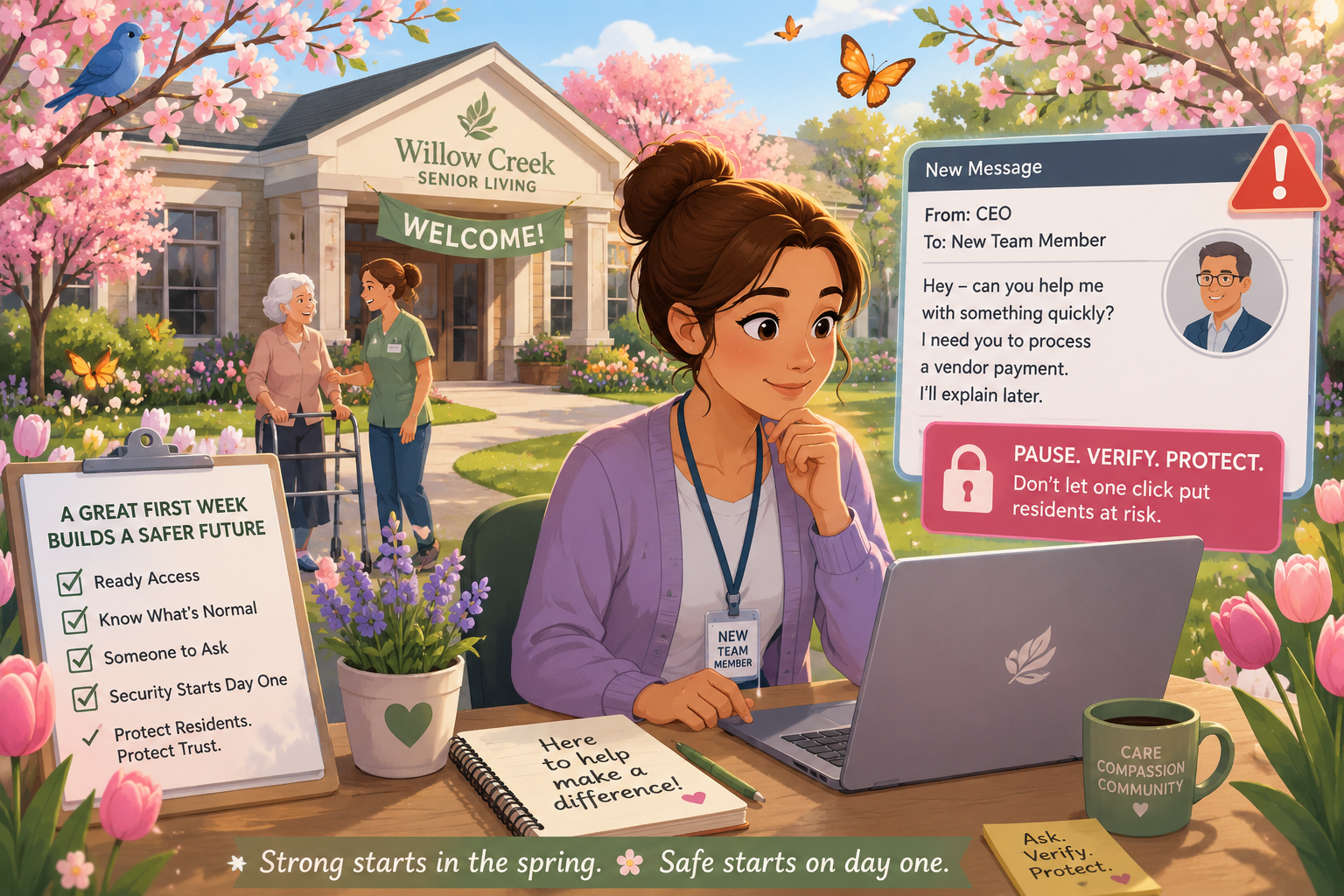
The email shows up on a Tuesday morning.
It looks like it’s from the Executive Director. The name matches. The tone feels familiar. Even the signature looks right.
“Hey — can you help me with something quickly? I’m tied up in meetings. I need you to process a vendor payment. I’ll explain later.”
The new employee pauses.
They’ve only been at your senior care community for four days. They’re still learning names, systems, and routines. They don’t yet know what’s normal — and they definitely don’t want to be the person questioning leadership during their first week.
So they try to help.
And just like that, the damage is done.
Why the First Week Is the Most Dangerous Week
Every spring and summer, assisted living communities across Minnesota bring on new staff members, interns, and seasonal employees. For senior care leaders, it’s onboarding season.
For cybercriminals, it’s opportunity season.
According to Keepnet Lab’s 2025 New Hires Phishing Susceptibility Report, new employees are significantly more likely to fall for phishing attempts than experienced staff. CEO impersonation emails are especially effective because new hires haven’t yet learned what “normal” communication looks like inside your organization.
And honestly, that makes sense.
A new employee doesn’t yet know:
- How leadership typically communicates
- Which payment requests are legitimate
- What security procedures should be followed
- Who to ask when something feels suspicious
They aren’t careless.
They’re trying to be helpful.
That’s what makes them vulnerable.
And if you manage a senior care facility, you probably already know which employees on your team would immediately jump in to solve a problem without wanting to “cause trouble” by asking too many questions.
The Real Risk Isn’t the Employee — It’s the Chaos
Now think back to your last new hire.
Was everything fully ready on day one?
Maybe the laptop wasn’t configured yet.
Maybe their Microsoft 365 account was still pending.
Maybe they borrowed a coworker’s login “just for today.”
Maybe they saved files locally because they couldn’t access the shared drive yet.
Maybe they used a personal phone to look something up quickly.
None of that feels dangerous in the moment.
It feels practical. Efficient. Helpful.
But in senior care environments, those small workarounds quietly create serious risks:
- Shared credentials nobody tracks
- Resident data stored outside secure backups
- Personal devices accessing sensitive information
- Staff unsure how to report suspicious activity
- Missing documentation for HIPAA compliance audits
The attack itself may happen later.
But the vulnerability often begins during onboarding.
And in healthcare and senior care, the stakes are higher than most industries.
A ransomware attack doesn’t just disrupt business operations. It can interrupt resident care, medication systems, scheduling, communication with families, and access to critical records.
That’s why cybersecurity in assisted living is no longer just an IT issue.
It’s a resident safety issue.
What a Secure First Day Actually Looks Like
The good news?
Fixing this usually doesn’t require long security seminars or complicated technology.
It starts with preparation.
1. Access Should Be Ready — Not Improvised
Before a new employee walks through the door:
- Their accounts should already exist
- Permissions should already be defined
- Multi-factor authentication should already be enabled
- Devices should already be secured and monitored
No borrowed passwords.
No temporary shortcuts.
No “we’ll fix it later.”
Those “temporary” workarounds often become permanent vulnerabilities.
2. New Hires Need to Know What’s Normal
This doesn’t need to be complicated.
A simple 10-minute conversation can prevent major problems:
- Would leadership ever request gift cards or wire transfers by email?
- What should they do if a request feels urgent or unusual?
- Who should they contact if something seems suspicious?
Most phishing attacks succeed because employees are uncertain — not because they’re careless.
Clarity builds confidence.
3. Give Them a Safe Place to Ask Questions
This might be the most important step of all.
Most first-week mistakes happen quietly because new hires don’t want to look inexperienced.
In senior care especially, staff often feel pressure to move quickly and solve problems independently.
But cybersecurity works best when people feel safe slowing down long enough to ask:
“Does this look right to you?”
One trusted point of contact can prevent a major incident.
Senior Care Facilities Are Increasingly Being Targeted
Many assisted living leaders still believe their organization is “too small” to attract attackers.
Unfortunately, cybercriminals often prefer smaller healthcare and senior care organizations because they typically have:
- Limited internal IT staff
- Aging technology systems
- High employee turnover
- Sensitive resident data
- Fewer security controls in place
And because resident care cannot stop, ransomware attackers know facilities may feel pressured to pay quickly to restore operations.
That’s exactly why cybersecurity and compliance readiness matter now more than ever.
Most Security Failures Start Before the Attack
The truth is, most breaches don’t happen because someone intentionally ignored the rules.
They happen because:
- Nobody explained the rules clearly
- Systems weren’t fully prepared
- Staff felt rushed
- Security became optional during busy onboarding periods
In senior care, where trust means everything, those small gaps can become very expensive problems.
Not just financially.
Emotionally.
Operationally.
Reputationally.
One Simple Conversation Could Prevent a Crisis
Maybe your onboarding process already feels organized.
Maybe your community is small enough that new hires get more personal attention.
But if you’ve ever had an employee improvise their way through the first week — even once — it’s worth taking another look at your onboarding process before the next phishing email arrives.
Because cybersecurity isn’t just about technology anymore.
It’s about protecting your residents, your staff, your reputation, and the trust families place in your community every single day.

.png)