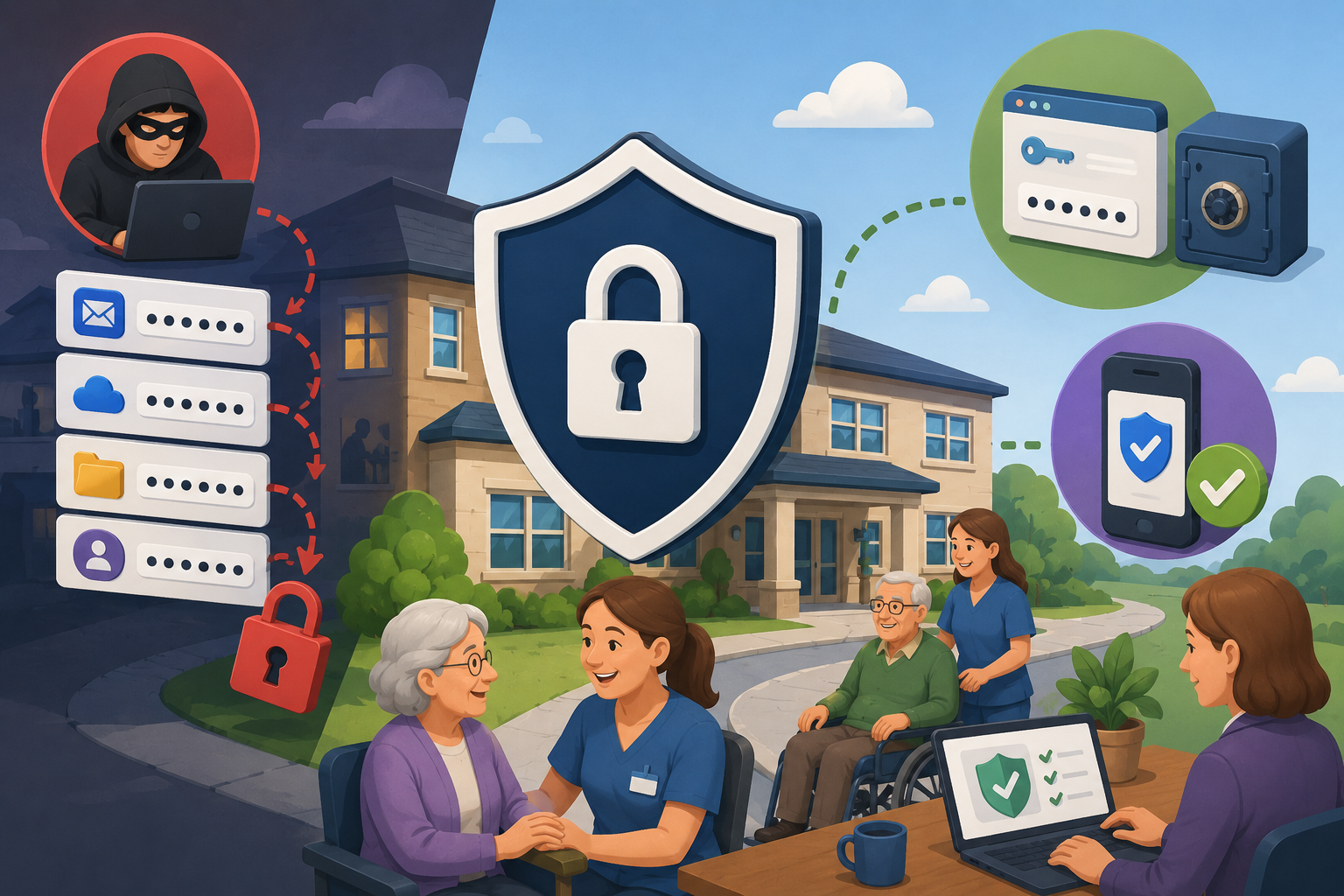
Why Password Reuse Is a Serious Risk for Senior Care Providers
Picture walking up to a house and lifting the welcome mat to find a key underneath.
It’s convenient. Predictable. And exactly where someone with bad intentions would look first.
Unfortunately, many businesses handle passwords the same way.
For assisted living and senior care communities, that small habit can create a very big problem.
Today’s cybercriminals are not just targeting large hospitals or national healthcare systems. They are increasingly going after smaller healthcare organizations and senior care providers because they know many facilities are already stretched thin.
And most attacks don’t start with sophisticated hacking.
They start with a reused password.
One Password Can Open Every Door
Most data breaches do not begin inside your organization.
They often begin with a completely unrelated website.
Maybe it was a shopping account. Maybe a food delivery app. Maybe an old subscription someone on your team forgot they even had.
That company gets breached, and suddenly usernames and passwords are exposed online.
From there, attackers use automated software to try those same credentials everywhere else:
- Email accounts
- Microsoft 365
- Payroll systems
- Resident management platforms
- Cloud storage
- Financial portals
This type of attack is called credential stuffing.
It is simple, automated, and extremely effective.
If a staff member reused the same password across multiple systems, one stolen login can quickly turn into full access to sensitive business data.
For senior care organizations, that could include:
- Resident health information
- Billing records
- Social Security numbers
- Employee payroll data
- Family contact information
And when healthcare data is involved, the consequences are not just operational.
They can become compliance issues, reputational issues, and resident trust issues.
A Cybernews study of 19 billion exposed passwords found that 94% were reused or duplicated across multiple accounts.
That means most people are unknowingly using one key for every digital door in their lives.
Strong Passwords Alone Are No Longer Enough
Many people still believe a “strong password” means adding:
- One capital letter
- One number
- One symbol
That may have worked years ago.
Today, attackers use automated tools capable of testing billions of password combinations in seconds.
Passwords like:
- Password1!
- Welcome2025
- Vikings#1
can often be cracked almost instantly.
Longer passwords are far more effective than complicated-looking passwords.
Something simple but lengthy — like a passphrase — is significantly harder to crack.
But even strong passwords still have one major weakness:
If they are reused, they become a master key.
That is why modern cybersecurity is no longer just about creating better passwords.
It is about building better systems.
Why This Matters So Much in Senior Care
Senior care communities face unique cybersecurity risks.
Many facilities:
- Have limited internal IT resources
- Depend heavily on cloud-based healthcare systems
- Support remote staff access
- Use connected devices like cameras, nurse call systems, and smart building technology
- Must comply with HIPAA and other privacy regulations
A ransomware attack or account compromise can disrupt operations quickly.
In some cases, staff may lose access to systems needed for resident care.
Families lose confidence. Boards demand answers. Insurance carriers begin asking difficult questions.
And administrators are left wondering whether the organization was truly prepared.
The reality is this:
Cybersecurity is no longer just an IT issue.
It is part of resident safety, operational continuity, and family trust.
The Two Simple Changes That Reduce Most Password Risks
The good news is that improving password security does not have to be overwhelming.
Two simple changes dramatically reduce the majority of credential-based attacks.
1. Use a Password Manager
Password managers like:
- 1Password
- Bitwarden
- Dashlane
create and store unique passwords for every account.
That means your accounting software, email platform, payroll system, and resident management tools all use different credentials.
Staff members do not need to remember dozens of complicated passwords.
More importantly, they stop reusing them.
Every account gets its own key.
2. Turn On Multi-Factor Authentication (MFA)
If your password is the lock, MFA is the deadbolt.
MFA requires:
- Something you know (your password)
- And something you have (like a phone prompt or authentication app)
Even if someone steals a password, they still cannot access the account without the second layer.
For many cyber insurance providers, MFA is no longer optional.
It is becoming a baseline requirement.
Good Security Should Protect People From Human Mistakes
The truth is:
People will forget passwords. They will reuse passwords. They will occasionally click something they should not.
Good cybersecurity planning assumes this will happen.
The goal is not perfection.
The goal is reducing risk before a small mistake becomes a major incident.
That is why the strongest organizations focus on layered protection:
- Password managers
- MFA
- Security awareness training
- Email protection
- Endpoint security
- Backups and recovery planning
Together, these systems create resilience.
A Simple Question Worth Asking
If someone on your team reused a password today and it was exposed in a breach somewhere else…
How many systems could an attacker access?
For many senior care providers, that answer is uncomfortable.
But fixing it is often easier than people expect.
And the peace of mind that comes from knowing resident data, staff accounts, and critical systems are better protected is worth it.
Because protecting your organization is not just about technology.
It is about protecting your residents, your reputation, and the trust families place in your care every single day.
If you would like help evaluating your organization’s password security, MFA readiness, or HIPAA cybersecurity posture, our team specializes in supporting Minnesota senior care and assisted living providers with practical, easy-to-understand cybersecurity guidance.
We help you simplify the process so you can focus on what matters most — caring for your residents.
.png)