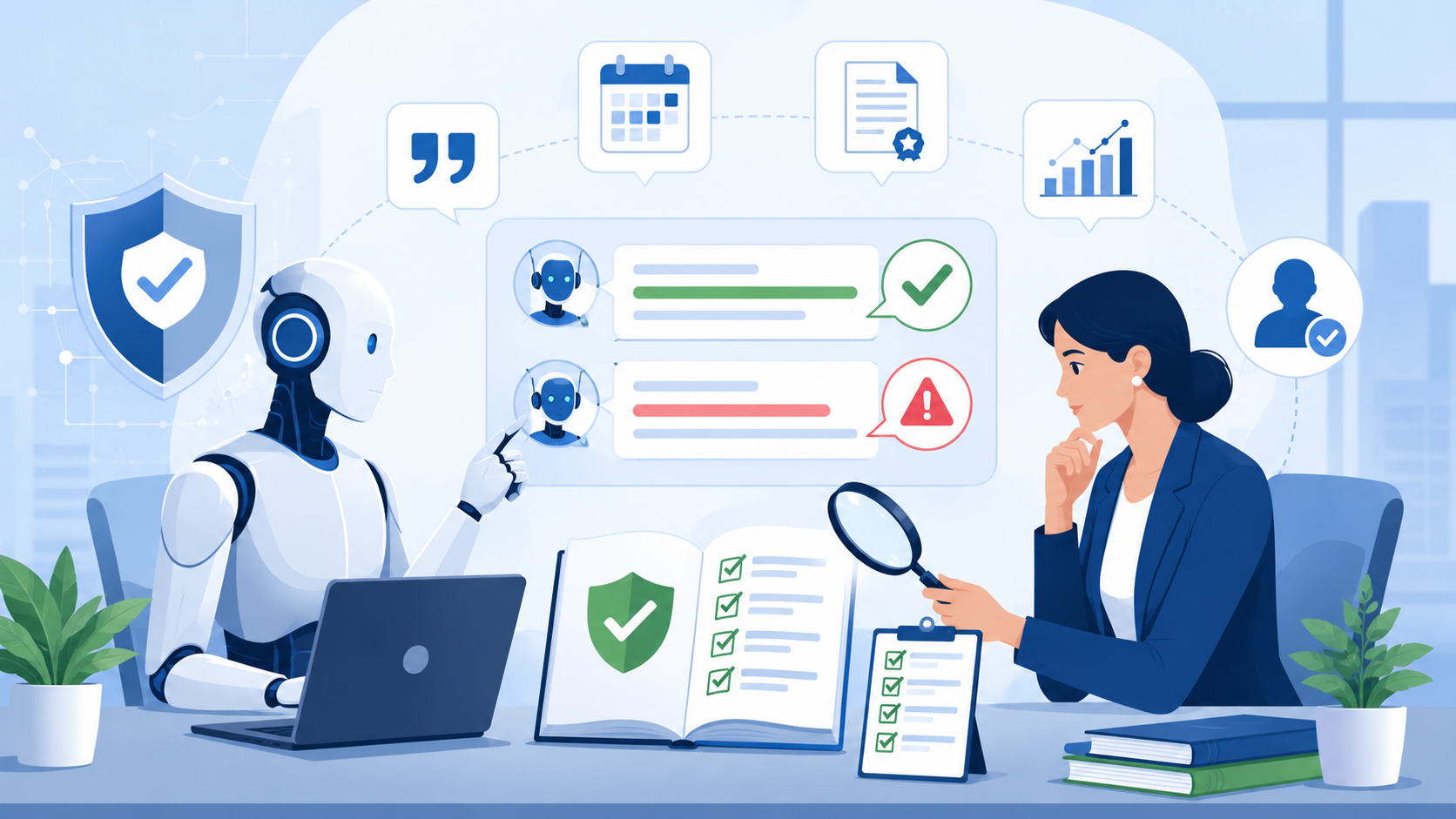
A Confident Answer Is Not Always a Correct Answer
Artificial intelligence can produce clear, polished, and highly specific answers that are incorrect. It may invent a fact, quotation, source, date, case, statistic, or policy provision while presenting the information with complete confidence.
This behavior is often called an AI hallucination. The system is not intentionally lying. It does not understand truth or recognize that it is wrong in the same way a person might. It generates a plausible response based on patterns in the information it learned.
Tone is not a useful accuracy signal. A correct answer and an invented answer can be equally fluent, well formatted, and convincing.
What an AI Hallucination Looks Like
Hallucinations often appear in specific details. An AI system may provide a precise clause number in a standard, a quotation attributed to a real person, a study that does not exist, or a date that sounds reasonable but is incorrect.
The specificity can make the answer feel authoritative. A section number, publication title, or detailed explanation gives the impression that the system consulted a reliable source. Unless the user checks the original material, the invented detail may move into an email, report, presentation, policy, or customer recommendation.
The danger is not that every AI answer is wrong. The danger is that incorrect answers may not look different from correct ones.
Why Hallucinations Happen
Generative AI predicts likely words and phrases. It learned patterns from large collections of text, but it is not automatically performing a live fact lookup every time it responds.
When the model has incomplete information, it still tries to create the most plausible continuation. It may combine familiar concepts, names, or formats into an answer that sounds right. Unless the system is specifically connected to reliable sources and instructed to use them, fluency can fill the gap where evidence is missing.
This is why asking the same question again or asking the AI whether it is certain does not guarantee accuracy. The model may repeat or reinforce the same incorrect claim.
Why Unverified AI Output Creates Business Risk
An inaccurate fact can travel quickly. It can move from a chat window into a client email, management report, marketing campaign, contract summary, compliance document, or operational decision.
The immediate error may be small, but the larger cost is trust. When a customer, auditor, manager, or employee discovers a false statement, confidence in the rest of the work may decline. In high consequence areas such as legal, medical, financial, security, or regulatory work, an invented detail can cause much more serious harm.
The right response is not to avoid AI entirely. It is to treat AI as a drafting and analysis partner whose important claims require verification.
Verification Check 1: Use Trusted Sources
Cross check specific claims against reputable, independent sources. Prefer authoritative references such as government agencies, official vendor documentation, recognized standards bodies, primary research, or trusted industry organizations.
Do not rely on the AI’s own explanation as proof. A second confidently worded answer is still not an independent source.
Verification Check 2: Confirm Citations
Ask the AI to identify the source for a claim, then confirm that the source exists. Open it and make sure it actually supports the statement. AI systems may provide a real looking title, author, link, or publication that is incorrect or unrelated.
Check names, publication dates, page numbers, quotations, and context. A real source can still be misrepresented.
Verification Check 3: Read the Original Document
For contracts, policies, standards, laws, technical specifications, or customer documents, use the original material. A summary can save time, but it should not replace the source when precise wording matters.
Confirm definitions, obligations, exceptions, dates, and section references directly. This is especially important when the answer may influence compliance or a formal decision.
Verification Check 4: Use Human Expertise
For specialized or high consequence topics, ask a qualified person to review the conclusion. A colleague, attorney, accountant, clinician, engineer, security professional, or subject matter expert may recognize missing context that neither the user nor the AI noticed.
Human review does not mean ignoring AI. It means combining AI speed with professional judgment and accountability.
Treat AI Output as a Draft
Before relying on an AI answer, ask whether it contains a specific number, name, date, quotation, or citation. Those details deserve extra attention. Ask whether the same claim appears in a trusted independent source and whether you would be comfortable showing that source to a client, auditor, or manager.
AI is a powerful drafting partner. Verification is what makes it a trustworthy one.

.png)