Every January, the tech world explodes with predictions. You’ve probably seen them: AI this, blockchain that, virtual reality for everything. It can feel like the whole world is speaking a different language — one that leaves those of us in senior care wondering what actually matters for our mission.
If you’re responsible for the safety, trust, and compliance of a senior care community, you don’t have time to chase shiny tech fads. You need to know: What’s real? What’s hype? And most importantly, what will help protect your residents and your reputation?
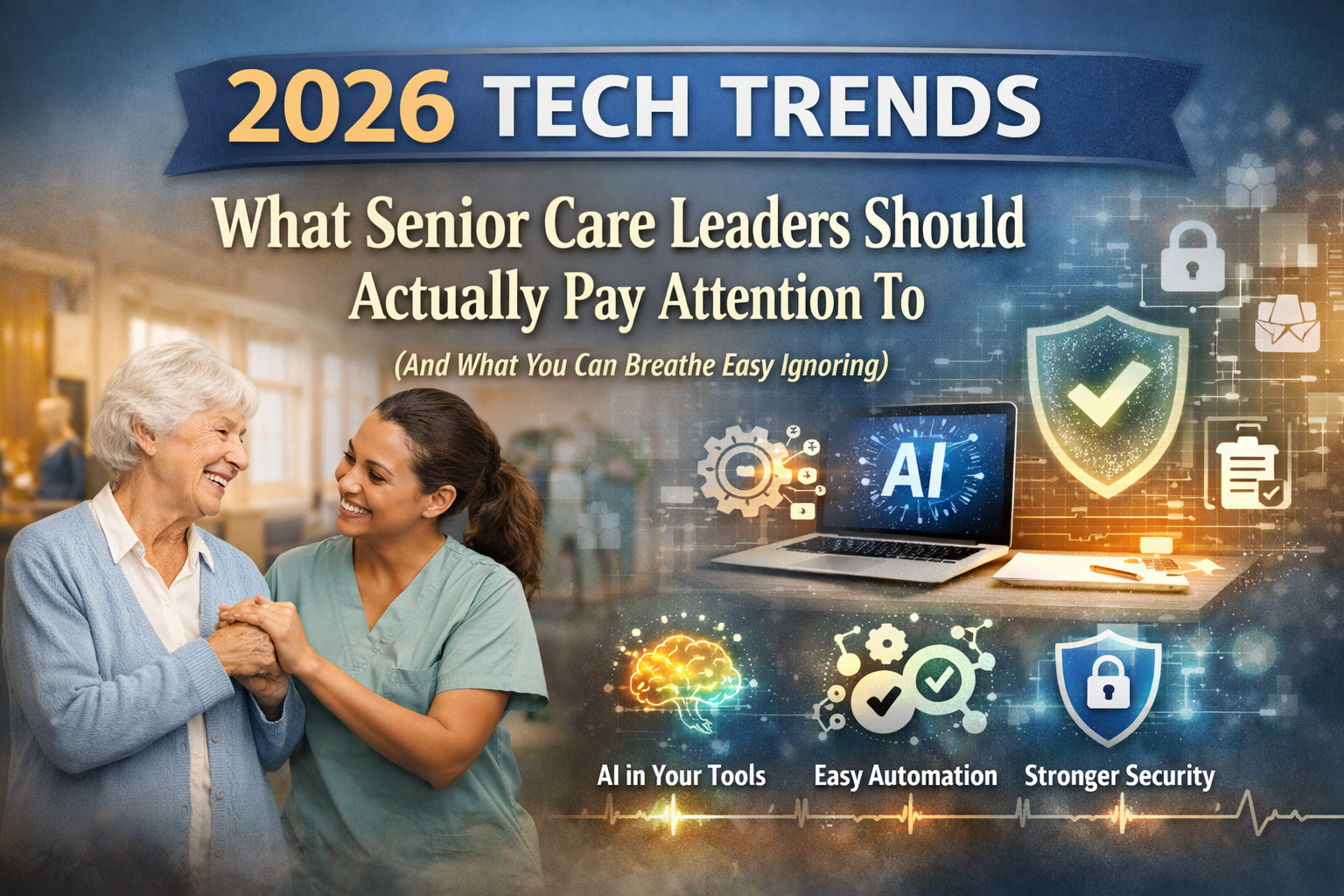
Let’s simplify things. Here are three trends worth your attention — and two you can safely ignore in 2026.
✅ 1. AI Is Quietly Improving the Tools You Already Use
What it means:
This year, artificial intelligence is no longer a separate “thing” you have to learn. It’s becoming part of your everyday tools — like email, Microsoft Word, and your calendar.
Think of it like this:
- Your email drafts replies for you.
- Your accounting system flags unusual charges.
- Your CRM writes follow-up emails based on past conversations.
- Even Slack summarizes long conversations so you can stay focused.
- Your EMR (like PointClickCare or MatrixCare) may soon use AI to flag care risks, identify documentation gaps, or recommend interventions based on resident data — all in real time.
Why it matters to you:
You don’t have to “learn AI.” You just need to turn on the smarter features in tools you already use — many of which you’re already paying for.
What to do:
The next time your software shows a new AI feature, give it two weeks. Try it. Some might be gimmicky, sure — but others could save you hours or even help you improve care outcomes.
⏱️ Time needed: Almost none. You’re already using the tools. Just try the upgrades.
✅ 2. Automation Is Finally Accessible — Without Needing an IT Team
What it means:
You don’t need a developer to create helpful automations anymore. Tools now let you describe in plain English what you want to happen — and AI makes it work.
Imagine saying:
“When a new resident is added, create a welcome folder, send the family a checklist, and remind me to follow up in three days.”
And just like that… it’s done.
Why it matters to you:
Many senior care teams put off automation because it felt too technical. But in 2026, it’s not. It’s fast, intuitive, and a great way to reduce errors and free up staff time.
What to do:
Pick one repetitive task your team does weekly — like logging incidents or sending training reminders — and ask an automation tool to handle it.
⏱️ Time needed: 20–30 minutes once. Then it runs on its own.
✅ 3. Cybersecurity Rules Are Getting Real (And You’ll Be Held Accountable)
What it means:
In the past, cybersecurity was a “should.” In 2026, it’s a legal “must.” Regulators, insurers, and families are all watching — and they expect your facility to have basic protections in place.
What used to be best practices — like multifactor authentication or backups — are now becoming requirements. And if something goes wrong, “we didn’t know” isn’t good enough anymore.
Why it matters to you:
In Minnesota, senior care facilities are being reviewed more closely by CMS and insurance carriers. If your systems are weak, you may face fines, lawsuits, or even reimbursement issues.
What to do:
Make sure your facility has these three essentials in place:
- ✅ Multifactor authentication on all business accounts
- ✅ Regular backups — and proof that they work
- ✅ A written cybersecurity policy you actually follow
⏱️ Time needed: 2–3 hours to get set up. Ongoing peace of mind.
❌ You Can Ignore: The Metaverse for Business Meetings
Let’s be honest — you don’t need to meet your staff as digital avatars in a virtual room. A Zoom call works just fine.
Unless you're in real estate or 3D design, skip the VR headset. It’s expensive, clunky, and solves problems you probably don’t have.
What to do:
Nothing. Save your budget for what matters.
❌ You Can Ignore: Accepting Cryptocurrency Payments
Unless your residents' families are specifically asking to pay with Bitcoin (and let’s be real — they’re probably not), crypto adds more complexity than value.
The risks? Tax issues, unstable pricing, and extra accounting headaches. Most senior care providers won’t touch it — and you don’t need to either.
What to do:
Stick with cards, checks, and ACH. If someday your families start asking for crypto, you can reevaluate then.
💡 The Bottom Line
If you’re an executive director, administrator, or owner of a senior care facility, remember this:
🟣 The best technology isn’t flashy — it’s the kind that quietly reduces risk, saves time, and protects your residents.
In 2026, focus on:
✔️ Smart features in tools you already use
✔️ Simple automations that ease staff burden
✔️ Meeting the cybersecurity standards now expected of you
And ignore the hype that doesn’t serve your mission.
🌿 Want clarity on what really matters for your facility’s tech, security, and compliance in 2026?
Schedule a free consult with our team. No jargon. No pressure. Just a practical review of where you stand — and how to make things easier for you and your team.
📅 Give us a call at 763-335-9255 or email us at info@bouncebacksolutions.com
Because your job is already complex. Let’s make sure your tech isn’t.
.png)